A handful of large developers build the majority of new homes in the UK. If you are buying a new build, the chances are your home is being built by one of them. Knowing who they are, how they operate, and what buyers commonly experience can help you ask better questions, set realistic expectations, and protect yourself before and after you complete.
This guide covers the major players, what distinguishes them, and what every buyer should do regardless of which developer they are buying from.
The major UK housebuilders
The UK new build market is dominated by a relatively small number of volume housebuilders. Here is an overview of the main ones buyers are likely to encounter.
| Developer | Also trades as | What buyers should know |
|---|---|---|
| Barratt Developments | David Wilson Homes | The UK's largest housebuilder by volume. David Wilson Homes operates as a more premium brand within the same group. Barratt has won HBF 5-star builder status in multiple years and is generally considered one of the better-regarded volume builders. Quality naturally varies between individual sites and site managers, as is the case with any large developer. |
| Persimmon Homes | Charles Church, Westbury Homes | One of the UK's largest builders by volume. Some buyers and online critics have raised concerns about build quality in previous years, and Persimmon has responded by investing in quality improvement programmes and customer care. Many buyers report positive experiences, and the company is making noticeable efforts to raise standards across its developments. |
| Taylor Wimpey | Taylor Wimpey | One of the three largest UK housebuilders, with a broad portfolio of home types across many locations and price points. Taylor Wimpey has taken steps to address concerns around certain historic sales practices. The company continues to be a major presence in UK housebuilding and many buyers have positive experiences across its developments. |
| Bellway | Bellway | A large national developer with a broad range of home types across many regions. Bellway is generally well regarded at its price points and has a long track record in UK housebuilding. As with any developer operating at scale, quality and customer service can vary between individual sites and regional teams. |
| Vistry Group | Bovis Homes, Linden Homes, Countryside Partnerships | Formed through a series of mergers, Vistry Group has become one of the UK's most significant developers, covering affordable, private, and partnership housing under several brands. It is worth checking which brand and division your development falls under, as each has its own focus and approach. |
| Redrow | Now part of Barratt Developments | Traditionally positioned as a more premium volume builder and well regarded for its heritage-inspired designs. Now part of Barratt Developments, the Redrow brand continues to operate, and buyers can take some comfort in the wider resources of the Barratt group behind it. |
| Berkeley Group | Berkeley, St George, St James, St Edward | Focused primarily on London and the South East, Berkeley Group is generally considered one of the more premium UK developers. Known for urban regeneration projects and higher specification builds, it attracts buyers looking for well-located homes at the upper end of the new build market. A snagging inspection is still worthwhile on any new home, including at this level. |
| Crest Nicholson | Crest Nicholson | A medium-sized developer with a focus on well-designed homes, primarily in the South of England. Crest Nicholson has a long history in UK housebuilding and continues to deliver new homes across a range of sites. As with any developer, reviewing your warranty coverage and contract terms carefully before exchanging is sensible. |
Why the developer name is only part of the story
One of the most important things to understand about new build quality is that it can vary significantly from site to site, even within the same developer. Most developers aim to deliver good quality homes, with customer satisfaction, warranty obligations and brand reputation all being important to them. That said, even highly regarded developers can deliver sites where the quality falls below expectations, depending on a range of site-specific factors, and a builder with a mixed reputation can have excellent individual sites.
Several factors tend to matter more than the brand name:
- The site manager's experience and attention to detail on your specific development
- The subcontractors being used and how well they are supervised
- Completion pressure - developments where builders are rushing to hit quarterly targets tend to have higher snag rates
- How long the development has been running, later phases sometimes benefit from lessons learned on earlier ones
- The regional team overseeing the build, which can differ significantly in standards from the national brand
All major UK housebuilders receive complaints about build quality. The question is not whether snags will occur, they almost certainly will, but whether you are prepared to document and report them effectively when they do.
How to research a developer before you buy
Before exchanging contracts, it is worth spending time researching both the developer and the specific development you are considering. Some useful approaches:
Check the New Homes Quality Board (NHQB)
The NHQB is a government-backed body overseeing developer standards and the New Homes Ombudsman Service. Check whether your developer is a registered member and review any published resolution data.
Read the HBF Star Rating
The Home Builders Federation runs an annual customer satisfaction survey. Developers are rated from one to five stars. Bear in mind the rating covers the national brand, not individual sites, so treat it as a starting point rather than a guarantee.
Search owner forums and review sites
Sites like HomeOwnerAlerts, Trustpilot, and Google Reviews carry buyer feedback on specific developments. Look for patterns, isolated complaints are less meaningful than recurring themes across multiple buyers on the same site.
Visit the site and talk to existing residents
If earlier phases are already occupied, knock on a few doors. Residents are often willing to share their experience and can give you an honest picture of what the developer's aftercare has been like in practice.
Review the reservation agreement and contract carefully
Before you commit, have a solicitor review the contract. Check for any clauses relating to estimated completion dates, what happens if the developer misses them, and the scope of your warranty coverage.
The Consumer Code and your rights
Most major UK housebuilders are registered under the Consumer Code for Home Builders, which sets minimum standards for how developers must treat buyers before and during the purchase process. Separately, the New Homes Ombudsman Service provides a route for escalating complaints if your developer fails to resolve issues through their own process.
Your home will also almost certainly be covered by a structural warranty, most commonly provided by NHBC (Buildmark), Premier Guarantee, or LABC Warranty. Understanding what your warranty covers and for how long is an important part of protecting yourself as a buyer.
Affordable housing on new developments
Most large new build developments in the UK include a proportion of affordable homes alongside privately sold properties. This is a planning requirement under what are known as Section 106 agreements, which oblige developers to provide a percentage of affordable units as a condition of receiving planning permission.
Affordable housing covers several different tenure types. Shared ownership allows buyers to purchase a percentage of a property and pay rent on the remainder, with the option to increase their share over time. Affordable rent properties are let at below-market rents and managed by housing associations. Some developments also include homes allocated under local authority nominations.
A few things worth knowing as a buyer:
- Affordable units are built to the same structural standards as private homes on the same site and are covered by the same NHBC or equivalent warranty
- The proportion of affordable homes varies by site and is set out in the planning documents, which are publicly available on your local council's planning portal
- Affordable and private properties are sometimes on separate streets or blocks within a development, though this varies by site
- Housing associations manage the affordable properties after handover; the developer typically has no ongoing involvement with them once the site is complete
If the tenure split on your development matters to you, ask the developer directly and check the planning application before you reserve.
What to do when you get your keys
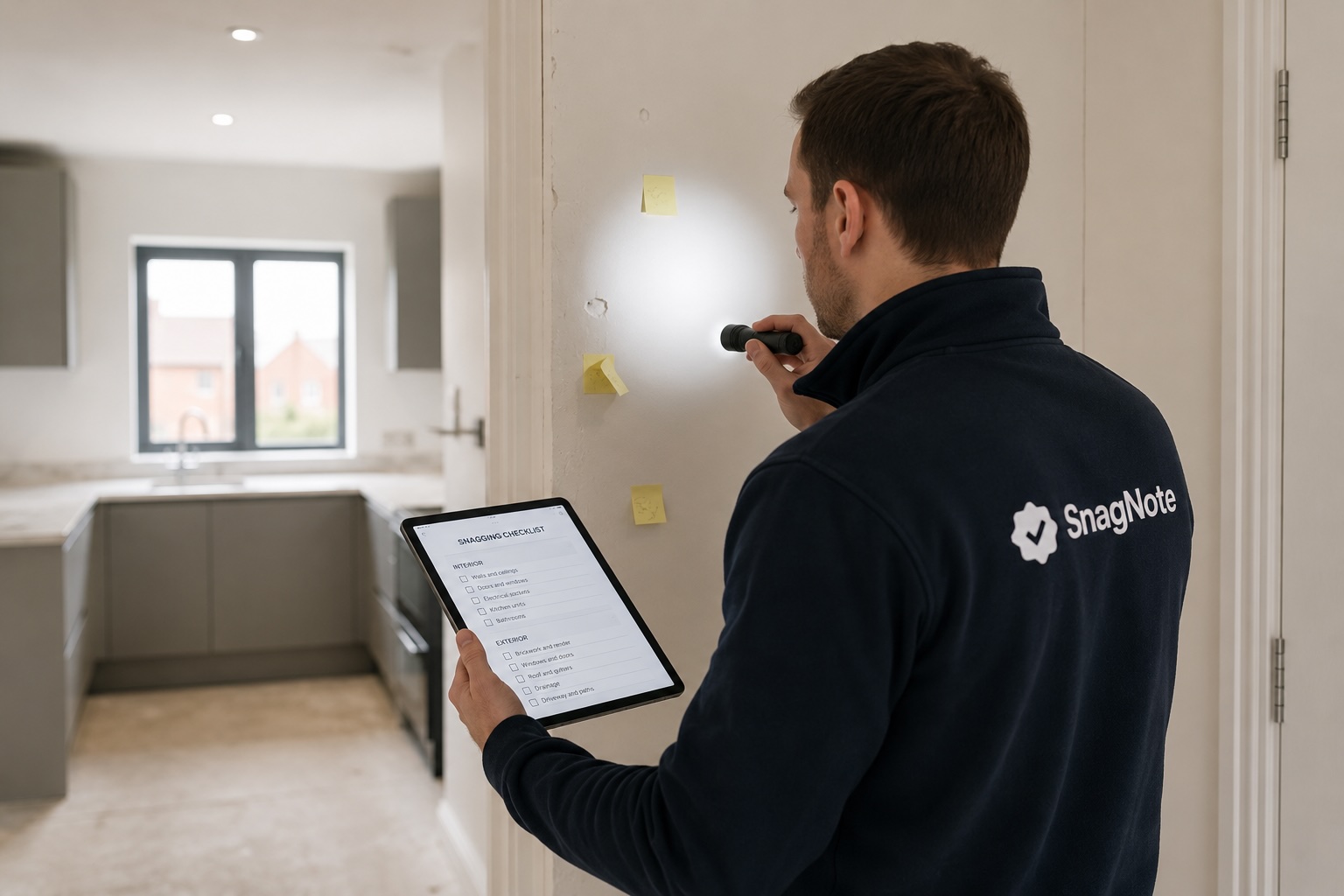
Regardless of which developer has built your home, the same applies when you complete: carry out a thorough snagging inspection as soon as possible and document everything you find. Every defect should be photographed, located precisely, and described clearly before being submitted to your developer in writing.
Developers are required to address defects reported during the initial defect liability period, but your ability to enforce this depends on having a clear, documented record of what you reported and when. Verbal reports are easy to dispute; written reports with photographs and timestamps are much harder to ignore.
SnagNote is built specifically for this process. Walk through your home room by room, log each defect with a photo, location, and description, and generate a professional report to send directly to your developer. It takes the same care and thoroughness you would bring to any inspection and turns it into something you can actually act on.

Log snags room by room with photos, locations, and notes, then generate a report to send your developer, whatever builder you are dealing with.
Disclaimer: This guide is for general information only. Developer reputations and practices change over time and vary significantly between individual sites. Always carry out your own research and seek independent legal advice before exchanging contracts on any new build property.